
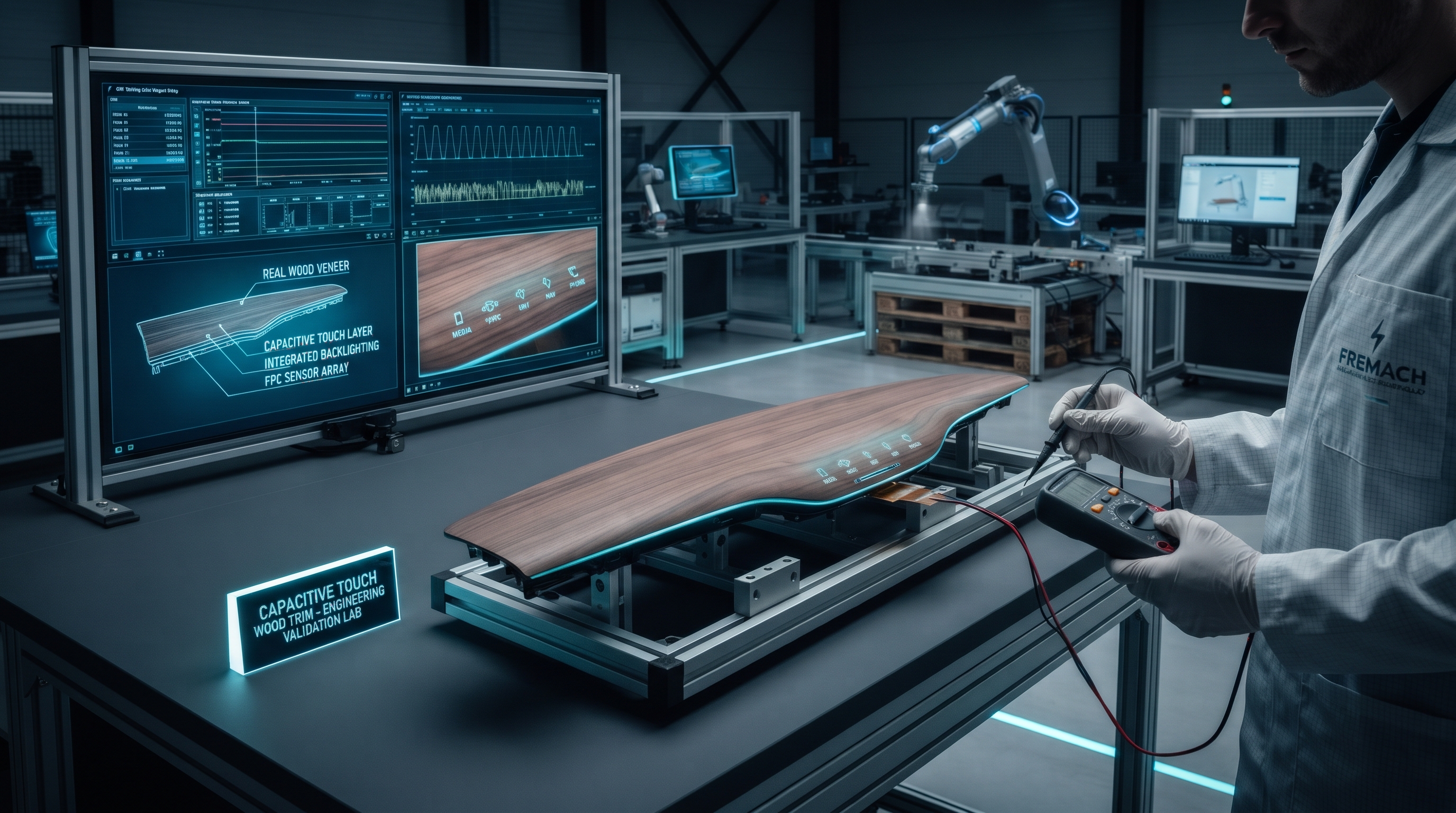
Capacitive touch under real wood: solving the SNR problem
A modern cabin now carries 15 to 25 discrete capacitive touch zones and one to three projected-capacitive (PCAP) touchscreens, and PCAP alone accounts for 63.5% of the switch market in 2026. At the same time, the design direction has reversed: OEMs no longer want the control to announce itself.
Why natural materials fight the sensor
Capacitive sensing depends on a predictable dielectric between electrode and finger. Natural materials do not offer one. Dry wood sits around εr 2 to 5 and rises with moisture content, and its value also shifts with grain direction. Leather runs εr 3 to 6 depending on tanning and moisture. Textile varies with weave density, fibre type, and humidity. All three are low and, more importantly, inconsistent: sample to sample, season to season, and across the life of the vehicle.
The consequence is a signal-to-noise target far above the industrial norm. A basic capacitive button works at SNR around 5:1. A natural-material automotive overlay needs SNR above 40:1 to detect a touch reliably through the covering while rejecting false triggers. The overlay itself is not thin: door-control films are specified to penetrate up to 3.0 mm of plastic or 1.2 mm of wrapped leather, at a key transmission rate of 75 to 82%. The sensing IC must then hold that margin while the baseline drifts with temperature across -40 to +85°C (-40 to +105°C near the windshield), under 15 to 150 Hz vibration and conducted EMI from alternators and ignition.
The IC is only half the answer
Modern sensor ICs do a great deal to recover margin: dynamic baseline calibration for drift, threshold hysteresis, and water-rejection logic. Differential mutual-capacitance is the key tool here, distinguishing the large, slow signature of a spilled drink from the small, fast signature of a finger, which is what keeps a door armrest from triggering itself when wet. A driven-shield ground layer handles EMI coupling from the door motor.
But an IC can only work with the signal the physical stack delivers. The electrode-to-finger path (electrode, optical adhesive, foam, overlay) sets the ceiling on achievable SNR before any firmware runs. Hidden-touch reliability is therefore a build problem, decided by how the sensor, the decorated skin, and the backing are laminated and moulded together, not something the controller can fix alone.
Where decoration and electronics converge
This is why hidden touch belongs to in-mould electronics (IME): print conductive ink onto a flexible film, thermoform it into the 3D shape, then injection-mould the structure behind it. That print-thermoform-overmould sequence is the same process chain as our thermoformed overlays and in-mould labelling. The research direction confirms the material payoff: the WoodTouch project (led by Hof University of Applied Sciences and Eberswalde University for Sustainable Development) prints capacitive sensors directly onto bio-based substrates beneath translucent real-wood veneer, with no discrete components, and has demonstrated weight savings up to 60% and a control unit reduced from 50 mm to 3.5 mm thick. The printed-electronics market behind this is projected to grow from USD 23 billion in 2025 to USD 63 billion by 2032. Horizon Europe's MULTIMOLD project is pushing the same IME chain toward printed piezoelectric sensing for harsh automotive conditions.
Building the module, not just the surface
This convergence is where we work. Our multi-component (2K/3K) moulding combines a structural backing layer with the decorated skin in a single process, which controls the electrode-to-surface geometry that governs SNR. Our electronics and PCBa integration brings the capacitive film, connector, and controller IC together into a finished trim module rather than a stack of separately sourced parts. Keeping decoration and electronics under one roof is what lets the dielectric budget be managed as one system.
The module still has to clear the full automotive gate: AEC-Q100 at the semiconductor level, CISPR 25 Class 5 for EMC, and the relevant functional-safety and ingress targets (ISO 26262, ISO 20653). Those are far easier to design toward when the surface material, the sensor, and the moulded backing are developed together from the start.
If your team is developing a decorated interior component with capacitive controls hidden under wood, leather, or textile, bring the part or the drawing to our engineers. We will work the material, the sensor stack, and the moulding as one problem.
Talk to our team
Stay in the loop.
Subscribe to our newsletter for new articles, project stories and technology insights. No spam, unsubscribe anytime.
Want to discuss a project?
Bring us a drawing, a target volume, or just a challenge. Our engineers review every brief and respond within two business days.