
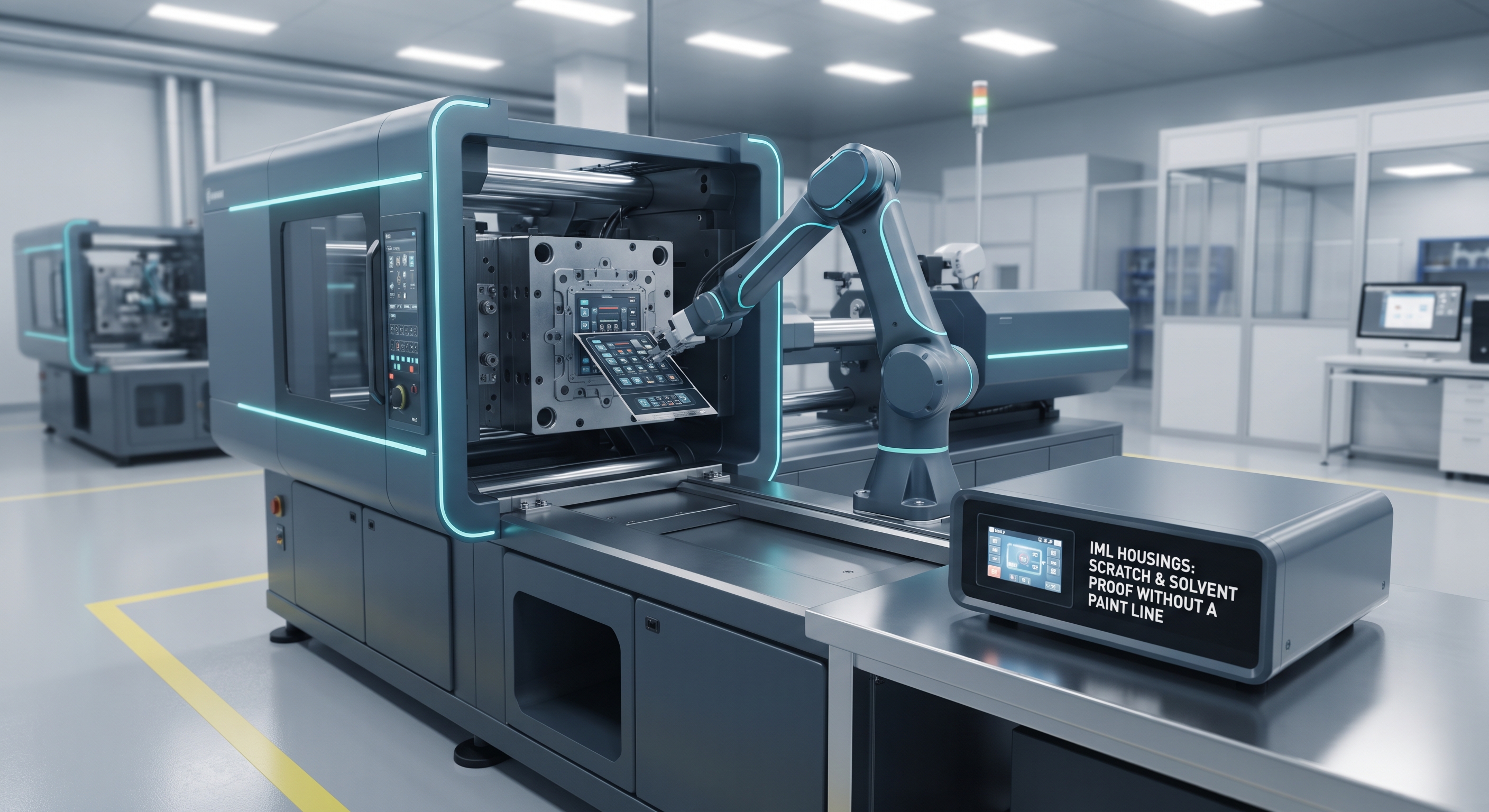
IML housings: scratch- and solvent-proof without a paint line
Walk through any maintenance bay or commercial kitchen and you will find the same failure: control graphics worn off a housing that still works perfectly. The on/off symbol is a grey smudge, the speed markings are gone.
Why the ink cannot wear off
The advantage is structural, not chemical. An IML build has three layers: a PET or PC outer film, the printed ink sandwiched in the middle, and the injected plastic substrate behind it. The graphic is never on the surface. It sits between the durable film and the substrate, so hands, solvents, and grit contact the film, not the ink.
That is the fundamental difference from in-mould decoration (IMD), where the ink ends up on the outer surface and can, over time, be touched off. With IML the film itself carries the wear. Add a PET hard coat and the surface reaches 2H to 3H pencil hardness, tested per DIN EN ISO 15184 and ASTM D3363 (500 g force, pencil held at 45°).
That number is not a marketing figure. Standard IML qualification pushes it further: a wear test rubs 500 g across the same spot 300 times over a two-inch stroke with no exposure of base material, and a humidity soak at 57 °C and near-saturation humidity for 48 hours must leave no cracking, fading, or delamination.
One step replaces a paint line
For anyone costing a programme, the process economics matter as much as the durability. IML decorates during moulding. The film is placed in the tool, the substrate is back-injected, and thermal and mechanical welding fuse film to plastic in the same cycle. There is no downstream paint booth, no separate print station, no cure oven, and no solvent-based coating to manage. That removes VOC emissions from the decoration step and takes cost and floor space out of the line.
It also widens what is geometrically possible. IML forms to depths of around 40 mm, versus roughly 1.5 mm for IMD, so it wraps recessed and raised features. Just as importantly, it can carry integrated press buttons, which is exactly what appliance panels and industrial controls need.
Matching the film and substrate to the duty
There is no single IML recipe: the discipline is matching materials to the environment. On the substrate side we work with PC for heat resistance and clarity, PC/ABS for a balance of toughness and finish, PP where chemical resistance and light weight lead, and ABS for impact. On the film side, PMMA gives premium surface hardness, PET gives dimensional stability at lower cost, and PC gives high formability for deep 3D features.
This is where process control earns its keep. Film and substrate have to bond under moulding heat: PP substrates run in the 200 to 250 °C range, and adhesion is confirmed by exposing the film to those temperatures and checking for peel or bubbling before a tool ever runs production. Getting the pairing wrong shows up as delamination in the field, not on the bench.
Where 2K adds the grip
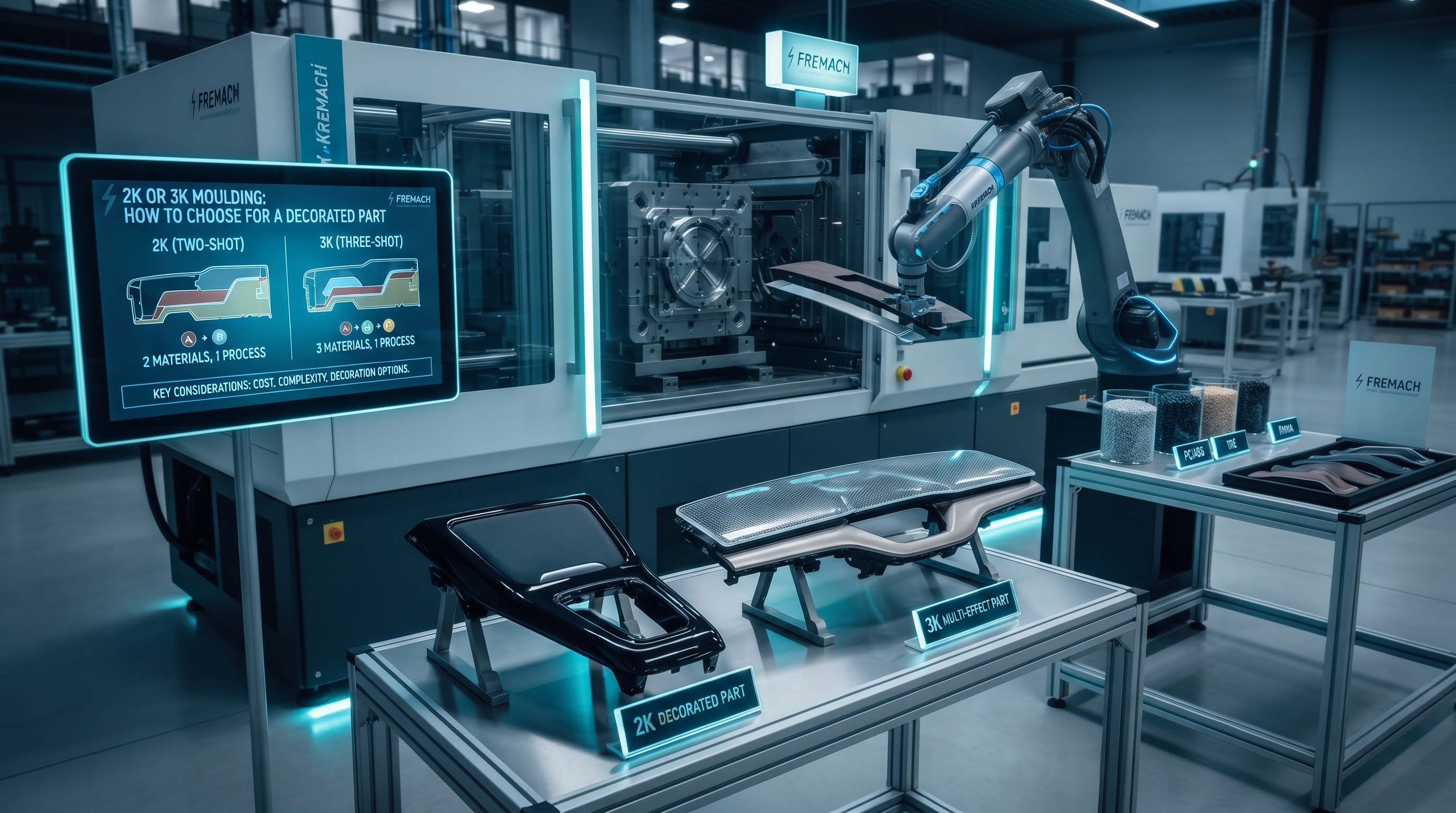
Housings for hand-held equipment often need more than a durable graphic. A power tool body wants a rigid shell and a soft, vibration-damping grip. We reach that with two-component (2K) moulding: a rigid substrate (typically 1.5 to 3 mm wall) overmoulded with a flexible zone (1 to 2.5 mm), the two materials chosen for chemical, thermal, and shrinkage compatibility so the bond holds. Combined with IML for the decorated, readable surfaces, a single moulded part can carry structure, grip, and permanent graphics with fewer assembly steps and better sealing at the interfaces.
IML has come a long way from the pre-labelled shampoo bottles P&G introduced it on in the 1970s. Today it is how we build appliance panels, tool housings, and industrial control faces that stay legible after years of cleaning and handling.
If you have a decorated housing that keeps coming back with worn graphics, or a new control panel that has to survive solvents and scrubbing, bring us the part or the drawing. Our engineers will work through the film and substrate pairing, the decoration, and any 2K or electronics integration alongside you.
Talk to our team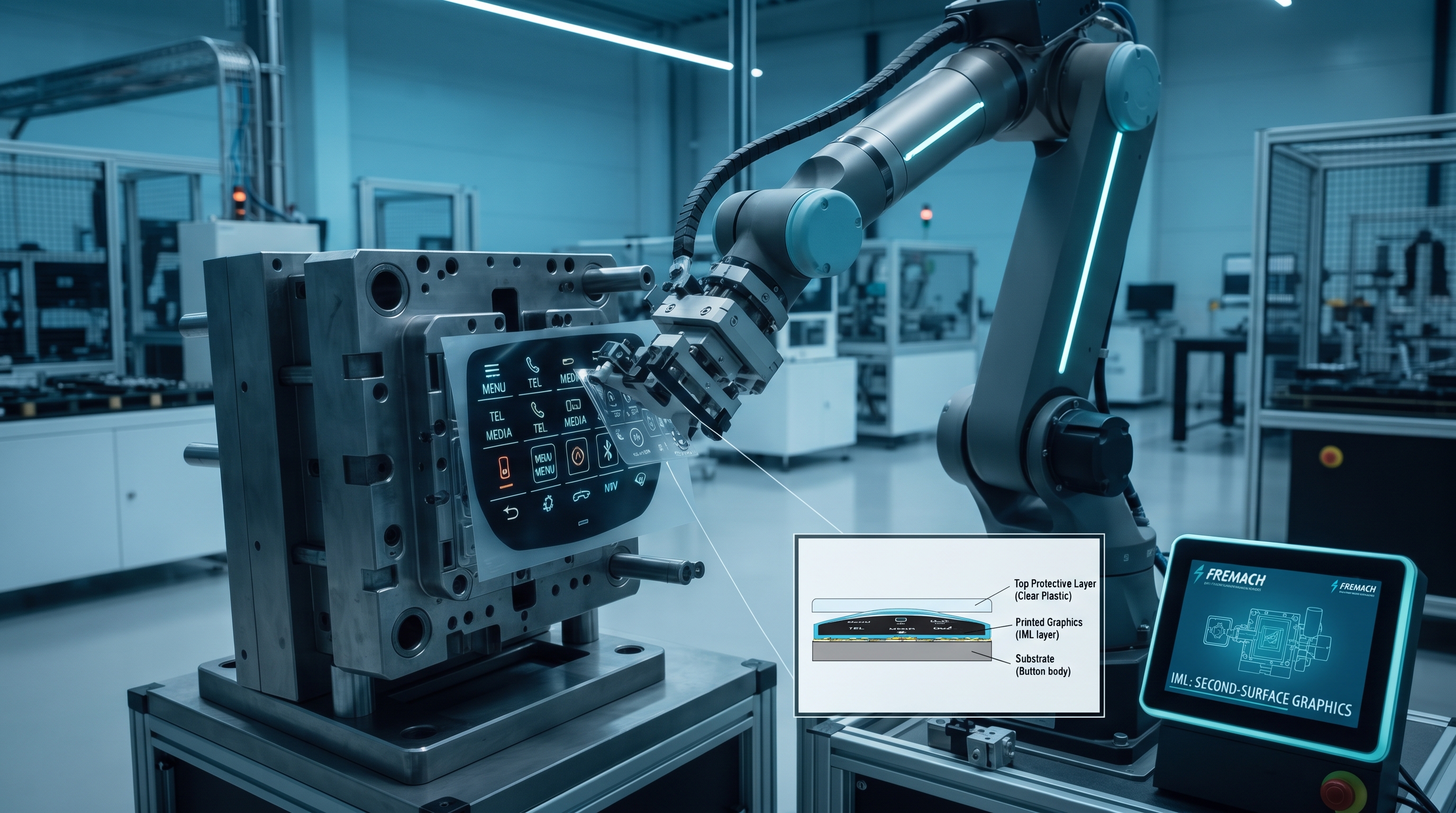
Stay in the loop.
Subscribe to our newsletter for new articles, project stories and technology insights. No spam, unsubscribe anytime.
Want to discuss a project?
Bring us a drawing, a target volume, or just a challenge. Our engineers review every brief and respond within two business days.