
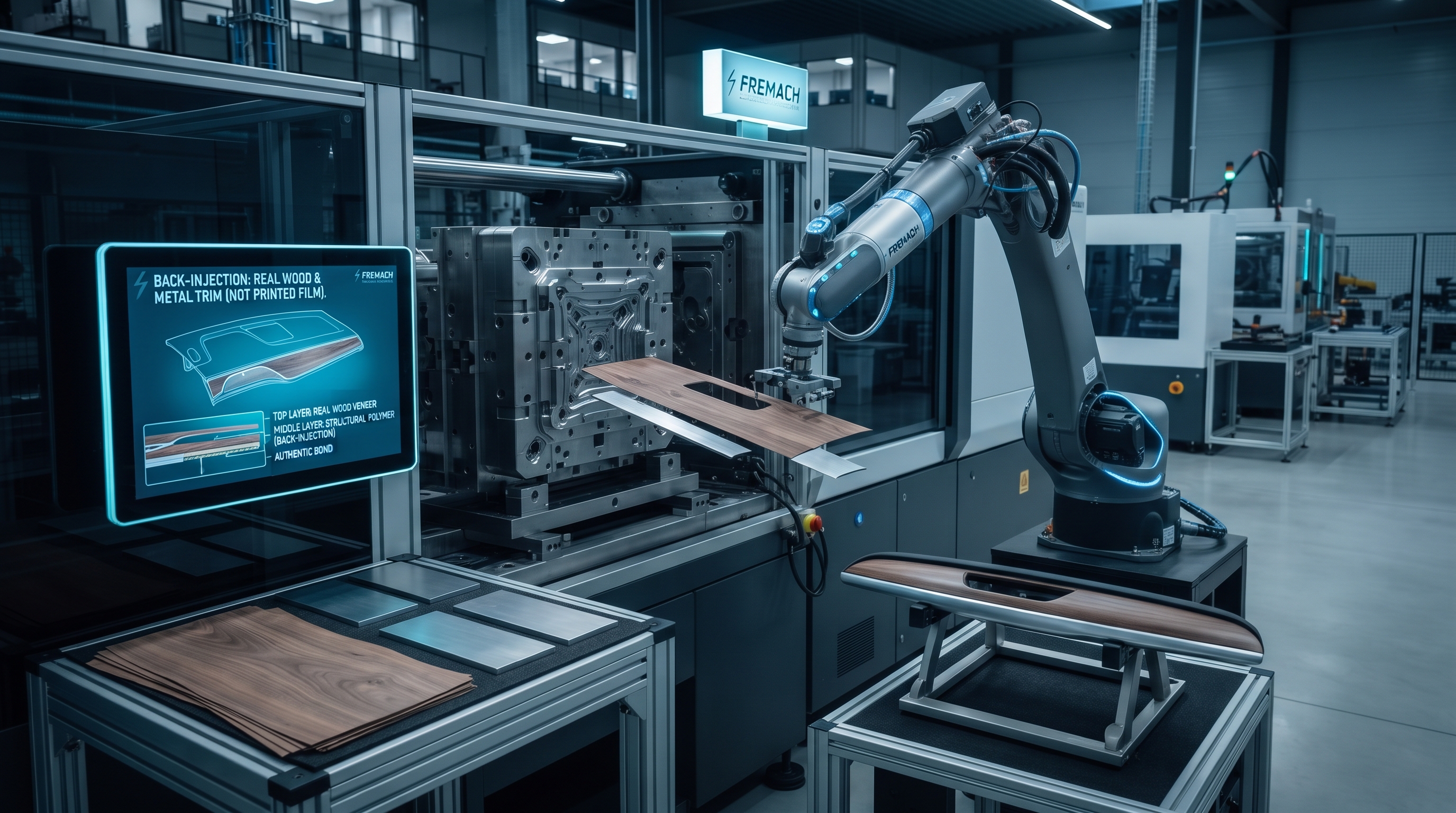
Back-injection: real wood and metal trim, not printed film
Premium interiors are now judged under the same light as the exterior paint.
What back-injection of real veneer actually demands
Real wood is not a drop-in substitution for film. A veneer is a structural, hygroscopic material, and it behaves like one in the tool. Work at the University of Warwick with WRAP (Makenji, Goodship, Buckley and Evered, Progress in Rubber, Plastics and Recycling Technology, Vol. 22, No. 4) back-injected real veneers onto PP and ABS, assessing adhesion integrity under severe boil testing alongside component shrinkage, with the veneer-to-polymer interface examined by SEM. Their samples moulded with good adhesion, but the discipline lives in controlling shrinkage and the interface, not in proving the concept.
The harder engineering question is how the veneer forms. Decorative veneers do not share the predictable orthotropy of a printed film. Tensile testing reported in BioResources on walnut burl and multilaminar ALPI-fineline technical veneer, using full-surface 3D digital image correlation, found that walnut burl lacks global directional dependency (closer to isotropic than orthotropic), while the technical veneer showed strong moisture and temperature sensitivity. The consequence: moisture expansion, stiffness scatter and ply thickness dominate the error budget, so forming and warpage must be predicted with classic laminate theory and layered-shell FE rather than assumed from a datasheet.
Trimming is equally specific. A study in Forests on shear-cutting of veneer showed drawing (angled) cuts reduce cutting force by roughly 85% against straight cuts, though with more fibre damage, that force peaks across the grain (90°), and that there is no benefit above about 300 mm/min. Species matter: beech cut with the lowest, most homogeneous force; maple with the widest variation. The value of that data is that forming and shear-cutting can be integrated into the injection tool itself, which is where the process earns its cycle time. Managing fragility is then a material-stack problem: Korean patent KR101791941B1 backs the veneer with a nonwoven moisture barrier, a forming-improvement layer that resists heat wrinkling and cracking, and a thermoplastic adhesive tuned to the injection resin, so a natural material survives thermoforming and melt-front pressure without telegraphing defects to the Class A surface.
Real metal: the cold touch you cannot print
Metal is the second authentic surface, and a different problem. In foil back-moulding, a real metal foil up to around 0.3 mm thick is held in the cavity like any insert, and any structure machined into the cavity wall (logos, decorative texturing) transfers faithfully into the finished face. While the tool is still closed after injection, an integrated punch separates the surplus foil so the cut edge wraps around the part, leaving a smooth edge with no overhang. The result is a genuine metal skin: thicker and more robust than an electroplated layer, permanently bonded, and carrying the cold metallic touch that signals quality before anyone reads a badge. Because warpage would ruin a Class A metal face, these parts are moulded in reinforced or filled thermoplastics for dimensional stability.
Where the skin becomes a function
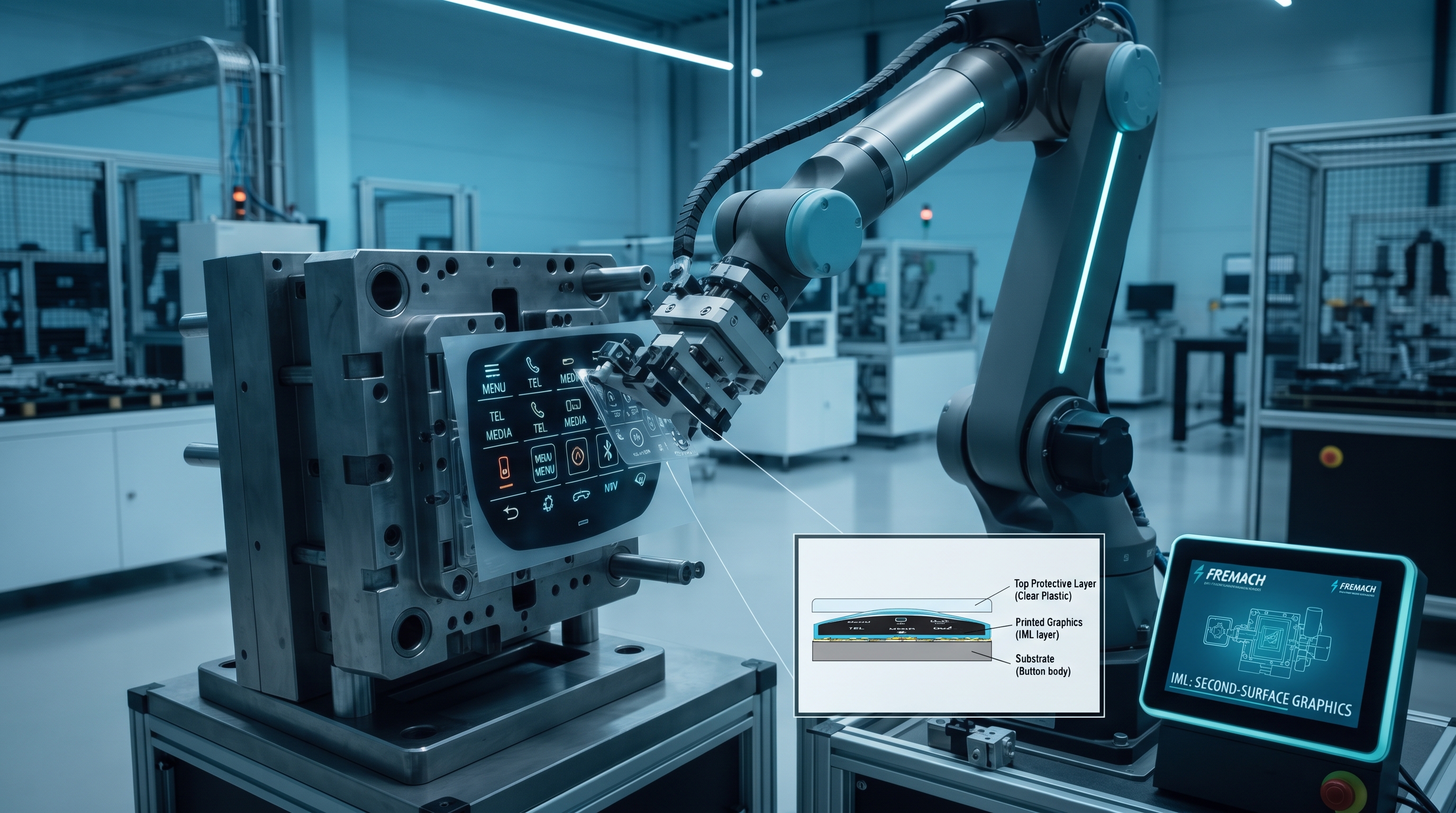
Authentic surfaces are now expected to do more than look right. Research published by SAE (15-19-01-0001) on light transmission through wood veneer compared modifying the veneer for transmittance, which proved structurally unstable, against laser-engraved micro-perforated beacons, and found a perforation diameter and spacing of 0.25 mm optimal for a controlled day/night effect. The same logic applies to perforated metal. This is where insert decoration stops being a finish and becomes an electromechanical assembly: a translucent veneer or a micro-perforated metal foil over a light guide and PCBa yields a surface that reads as plain wood or plain metal until it is illuminated, then shows switches, icons or ambient light. The sustainability case is moving the same way. The Volvo EX30 put flax-based natural-fibre A-surfaces into its dashboard and door trim by back-injection, on a single-material PP build that is far simpler to recycle than a PC/ABS stack and eliminates separate finishing steps.
Insert decoration is where our injection moulding, surface decoration and electronics integration meet in one process: multi-component (2K/3K) moulding to build the functional substrate and carrier geometry behind the facing, decoration expertise to place and form a real veneer or metal foil without compromising the Class A surface, and PCBa integration to light or make it touch-sensitive beneath a translucent or perforated skin. If your team is developing a premium or smart interior component and wants to move from a printed decor to the real material, bring the part or the drawing to our engineers, and we will work through the substrate, the facing and the integration with you.
Talk to our team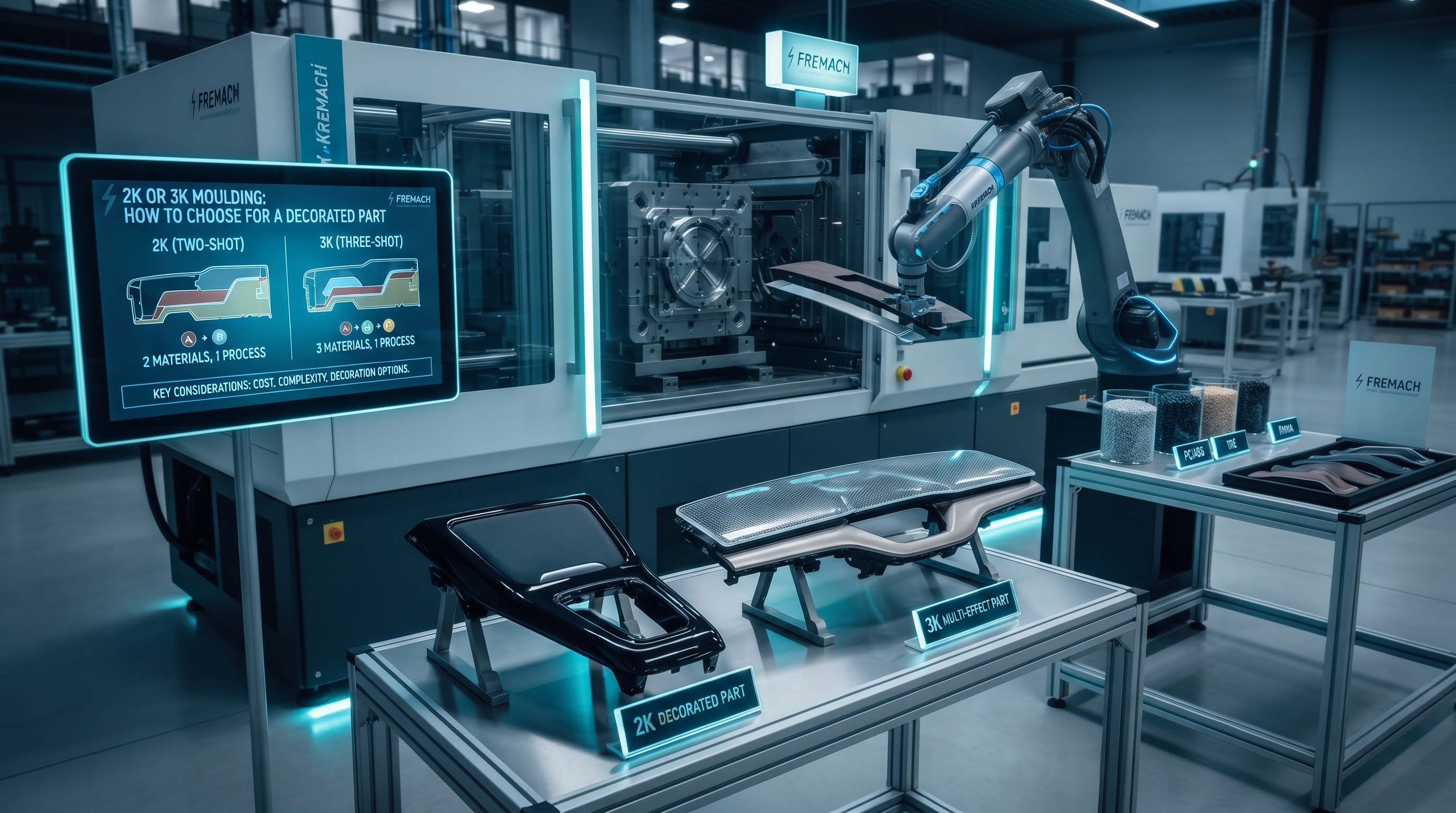
Stay in the loop.
Subscribe to our newsletter for new articles, project stories and technology insights. No spam, unsubscribe anytime.
Want to discuss a project?
Bring us a drawing, a target volume, or just a challenge. Our engineers review every brief and respond within two business days.